

Not all infrastructure is measured the same way.
Some assets are judged by how fast they move. Others by how many people they serve. Others by how much inventory, data, or connectivity they can handle in a day. But across ports, hospitals, telecom sites, and warehouses, there is one shared rule that matters more than most: the cost of interruption is rarely limited to the interruption itself.
A short power event can delay vessel handling, disrupt clinical equipment, interrupt network availability, or halt warehouse automation and cold-chain operations. The immediate incident may last minutes. The operational consequences can last far longer.
That is why the conversation around energy infrastructure is changing. The question is no longer only how to add more power. It is how to build more dependable power architecture around critical environments that are expected to remain stable, responsive, and efficient under real operating pressure.
For Gletscher Energy, that is where the market is becoming more serious. The company’s portfolio spans Makellos solar panels, Alloy inverters, Vertra UPS systems, and Onxy all-in-one storage, alongside enterprise-grade powerstations and supporting accessories, all positioned around long-term reliability, scalability, and infrastructure-grade application.
Downtime is no longer just an IT problem
For years, many businesses treated uptime as something mainly associated with data centers and server rooms. That view is now too narrow.
A modern port depends on synchronized systems: gates, cranes, lighting, reefer support, communications, security, and operational software. A hospital depends on continuity across imaging, monitoring, lab support, backup power coordination, and critical care environments. A telecom site depends on clean, stable, well-managed power because connectivity is now part of the basic operating layer of the economy. Warehouses have become increasingly automated, sensor-driven, and time-sensitive, especially where cold storage, fulfillment, or high-throughput logistics are involved.
In all four sectors, the infrastructure itself has become more digital, more interconnected, and less tolerant of unstable power conditions. That shifts energy from a background utility line item to a core part of operational design.
Ports need energy systems that support movement without friction
Ports are often discussed in terms of capacity, trade corridors, and efficiency. Less often discussed is how much of that performance depends on dependable electrical architecture.
Ports do not only need generation. They need layered resilience. Yard lighting, perimeter systems, administrative zones, control systems, reefer storage areas, monitoring equipment, and distributed operational assets all benefit from energy systems that can handle fluctuation, backup needs, and phased deployment.
This is where a combination of UPS, storage, inverter intelligence, and solar integration becomes more relevant than a single equipment decision. Gletscher’s Vertra UPS line is positioned around continuous backup performance with features including surge protection, AVR, remote monitoring, and options across line-interactive and online models, while its broader enterprise offering also includes Onxy storage, Alloy inverters, and Makellos solar panels for larger system logic.
For ports, the energy question is rarely “solar or no solar.” The better question is: which parts of the operating environment need immediate continuity, which need longer-duration resilience, and which can be improved through hybrid energy design over time?
That is a far more useful planning lens.
Hospitals do not buy power. They buy confidence.
Hospitals are among the clearest examples of why energy design should be treated as infrastructure strategy rather than equipment procurement.
The issue is not only backup. It is continuity quality. Sensitive equipment, critical circuits, monitoring systems, and essential services all need power environments that are stable, responsive, and managed with very little tolerance for disruption.
This is where Gletscher’s product architecture becomes relevant in a more layered way. Vertra UPS is described by Gletscher as suitable for continuous backup in offices, data centers, and industrial setups, with remote monitoring software, high battery efficiency, and user-friendly control, and the company’s research and government UPS material notes IoT-enabled monitoring with scalability from 5kVA to 500kVA.
For hospital environments, that kind of logic matters because medical infrastructure usually needs more than one protection layer:
- fast-response power continuity for critical equipment
- monitored backup visibility
- scalable architectures across departments or buildings
- compatibility with broader energy systems over time
This is also where storage becomes more than an emergency idea. Onxy AIO storage is presented by Gletscher as a system suitable for grid resilience, microgrids, critical infrastructure, solar backup, and hybrid-grid setups, with lithium, lead-acid, and sulfur-based chemistry options and, in Gletscher’s own technical materials, UL 9540 compliancenoted for commercial installations.
In practical terms, hospitals do not need marketing language around resilience. They need systems that reduce uncertainty.
Telecom infrastructure is distributed, exposed, and expected to stay on
Telecom sites are one of the clearest examples of why distributed energy architecture matters.
Unlike centralized facilities, telecom networks are spread across many smaller sites, often with different physical conditions, space constraints, and load profiles. Some are in dense urban environments. Others are in remote or edge locations. What they share is the expectation of continuity.
For these environments, compactness, remote visibility, compatibility, and long-cycle reliability matter just as much as headline output. Gletscher’s official materials position Vertra UPS around remote monitoring and stable backup, Alloy inverters across off-grid, on-grid, hybrid, and industrial use up to 500kW, and Onxy storage around hybrid-grid and backup applications.
That combination matters because telecom infrastructure often needs:
- stable transition during short disturbances
- monitored backup behavior
- flexible integration with solar or hybrid systems
- scalable deployment logic across site types
This is not glamorous infrastructure, but it is foundational infrastructure. And foundational infrastructure is exactly where downtime tends to be least acceptable and most publicly felt.
Warehouses are becoming energy-sensitive operating environments
Warehouses used to be thought of as simple boxes with lighting and forklifts. That picture is outdated.
Modern warehouse environments increasingly involve automation, scanning, refrigeration, inventory systems, conveyor logic, security infrastructure, and time-sensitive service levels. As a result, their tolerance for unstable power has dropped.
The energy strategy for warehouses is also broadening because many such sites now have usable roof space, service zones, and operating profiles that make hybrid energy systems more relevant. Gletscher’s Makellos range includes products positioned for commercial, industrial, utility-scale, and government energy infrastructure, with module classes ranging from 420W to 625W in the Makellos Element commercial line and up to 720W in Makellos Lite using TOPCon and PERC technologies. Gletscher also notes Makellos panels are built for harsh MENA conditions, with anti-dust, anti-humidity, and heat-oriented positioning.
Pair that with Alloy inverter systems for hybrid or grid-tied architecture and Onxy AIO storage for energy shifting or backup logic, and the warehouse conversation becomes much more interesting.
For warehouse operators, the real opportunity is often not just “save energy.” It is:
- reduce exposure to operational interruptions
- support automation and continuity
- improve site-level resilience
- build more visibility into power behavior over time

What critical infrastructure buyers are increasingly looking for
Across these sectors, the procurement mindset is becoming more mature.
Buyers are less interested in isolated products and more interested in whether a supplier can support a coherent system architecture. In practical terms, that usually means asking a different set of questions:
1. Can the system match the operating environment?
For Middle East infrastructure, that means heat, dust, humidity, load variability, and real maintenance conditions.
2. Can the power architecture scale over time?
Critical facilities rarely stand still. Capacity, automation, and complexity usually increase.
3. Is there visibility built into the system?
Monitoring, remote alerts, and performance insight matter more once uptime becomes a strategic KPI.
4. Does the supplier offer only hardware, or a broader system logic?
This is where portfolios matter.
Gletscher’s official enterprise and products pages present a stack that includes Makellos solar panels, Alloy inverters, Onxy storage, Vertra UPS, Stellar lighting, enterprise-grade powerstations, and EV charging support, framed as an integrated ecosystem rather than isolated categories.
That matters because infrastructure customers increasingly do not want to solve the same power problem five times through five unrelated vendors.
The Middle East context changes the standard
This topic matters globally, but the Middle East raises the bar.
Critical infrastructure in the region is often built for speed, scale, heat, and high expectations. That means reliability cannot be discussed abstractly. It has to be engineered around actual site conditions.
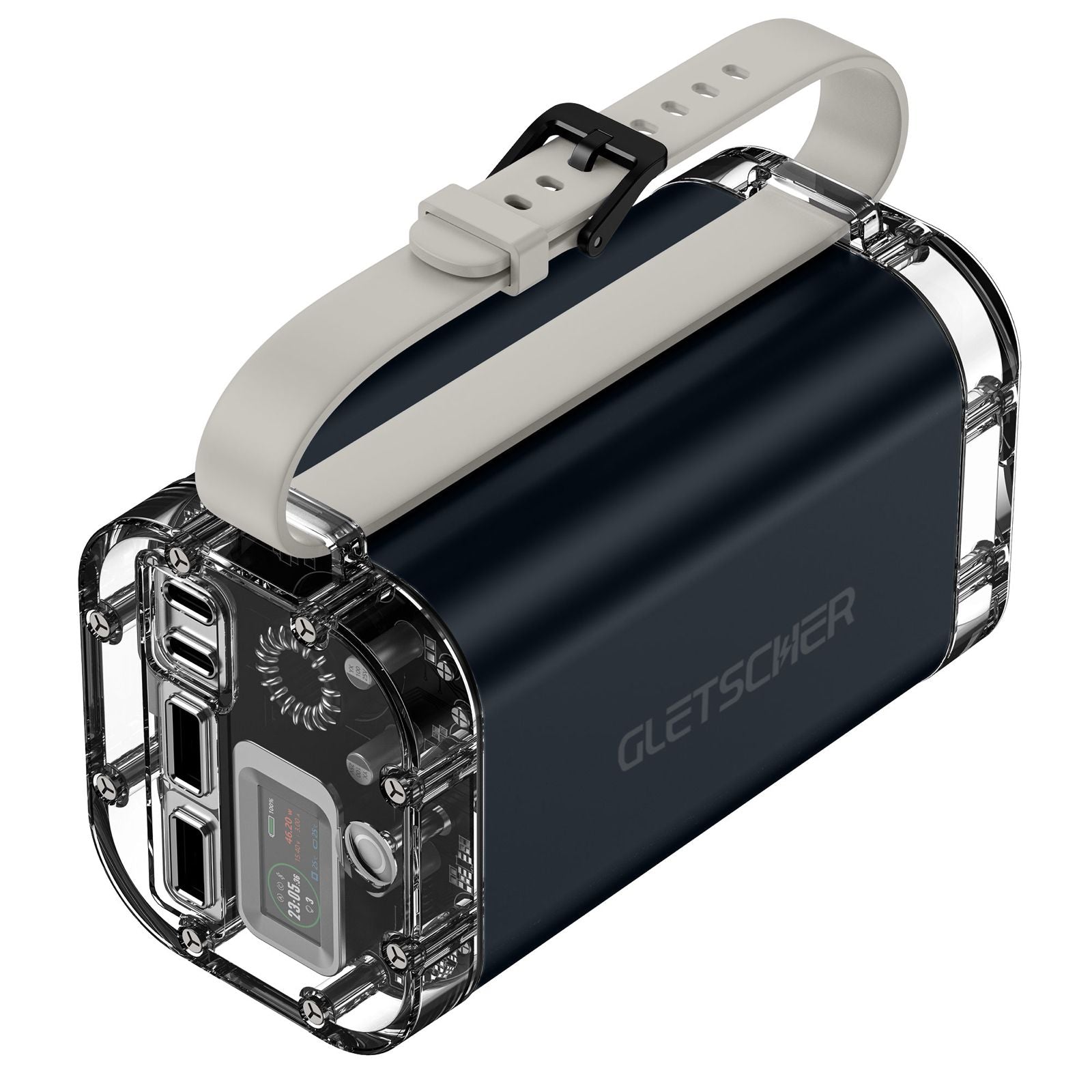
Gletscher’s own materials repeatedly position its infrastructure-facing technologies around desert use, harsh MENA conditions, weatherproof and fire-rated design, anti-dust performance, remote monitoring, and smart energy control. The enterprise portfolio highlights Camper Pro and Elite powerstations at 8kW to 13kW, while the broader platform frames its solutions around infrastructure-grade performance across grid-tied, off-grid, and distributed use cases.
The message is not that every site needs the same architecture. It is that serious infrastructure needs solutions designed for the conditions it will actually face.
Gletscher Energy’s place in this conversation
For Gletscher Energy, the value proposition is not simply that it supplies solar or backup equipment. It is that the company is building a portfolio around the kinds of environments where power continuity matters most.
That includes:
- Vertra for monitored UPS continuity
- Onxy for all-in-one storage and hybrid resilience
- Alloy for inverter-layer control across grid-tied, hybrid, and industrial scenarios
- Makellos for high-efficiency PV suited to demanding regional conditions
- supporting enterprise systems such as rugged powerstations, lighting, accessories, and smart energy control across infrastructure environments
That is the kind of structure that makes sense in sectors that cannot afford a casual approach to downtime.
The bigger point
Ports, hospitals, telecoms, and warehouses are different on paper. But from an energy perspective, they are beginning to converge around the same requirement: power systems have to be more dependable, more visible, and more intelligently designed than before.
That is where the next serious infrastructure conversation sits.
Not in whether organizations care about uptime. They already do.
The more important question is whether their energy architecture has kept pace with how critical their operations have become.
For the infrastructure that cannot afford downtime, that answer matters more every year.